Wednesday, 20 May 2020

5K Travel Limit


As this is written a 5 kilometre travel limit applies to the general public thanks to the COVID-19 pandemic.  Sadly cricket does not fall into the essential travel category but the thought occurred about how many games Clontarf CC might be able to play within that 5K limit.  Nowadays, not very many, Trinity falls just outside the limit.  However, many clubs have existed within the travel limit over the years and on a couple of occasions we have snuck just outside the official limit.  This list is not designed to be definitive; we leave that to Pat Bracken and his incredible work on mapping cricket throughout the years (Twitter @club_irl).  Indeed we have deliberately avoided Pat’s work in compiling this list and it will be interesting to see how many more we might have noted.

With limited resources, we have used the Irish times Archive, Club records including archive fixture cards and most interestingly, personal memories.  As a result there are some clubs about which we know quite a lot and others we know virtually nothing other than a mention in a fixture.  We will concentrate on a small number about which we have some detail.
Dollymount (1)
To begin with we stay very local and head towards the sea. Our first stop is Dollymount CC. Dollymount was founded in September 1895 and began playing the following year.  Lord Ardilaun was asked to act as the first President of the club “and his lordship has kindly consented to”   IT 10/3/1896. Despite being near neighbours to Clontarf the initial membership was in excess of 60, a very healthy number.  The club entered the Junior cup in 1896 and were drawn to play their local rivals, Clontarf, a true local derby.  Quite where the club played is uncertain, however they advertised that their field was situated just 3 minutes from the tram terminus. Another newspaper entry from 1906 refers to a game against Mr. Borland’s XI which was played at the Bull.  The 1906 averages show that the club played 15 games winning 8, losing 4 and drawing 3.  We can find no trace of the club from 1906
Cremore (2)
Cremore Cricket Club was a thriving and successful club for the period 1935 to 1962.  It was based in one of the newly built suburbs of Dublin in the late 1920s and the club operated on the land that is now occupied by Tolka Rovers FC.  During the winter, hockey was played, cricket during the summer and the ground became the playground for a generation of children of the area. Former member Stan McMullen remembers spending his childhood in the ground, although he moved on to play in Clontarf where he would have a very successful senior career.  That unfortunately became a common theme as the club produced many fine players who would make their name in other clubs.  The ground unfortunately was not of the highest order and this may have been a factor. Stan remembers the club hiring a steam roller in 1944 in an effort to improve the surface, a good idea, until the roller sank.  The quality of the facilities may well have been one of the factors in the refusal of the Leinster Cricket Union to grant senior status in the 1950s and this may well have signalled the beginning of the end for the club.   However there can be no doubting the quality of the players produced, the previously mentioned McMullen was a fine player for Clontarf who also benefitted when Johnny Bell (whose family now are connected with Pembroke), John McGivern, Niall Broderick arrived and who all gave long service to that club. Pride of place though was Alfie Cooper who not only won 2 caps for Ireland but also represented and captained USA after he emigrated in later years.  Clontarf were not the only club to reap the work of Cremore, Jimmy Spencer (a player that McMullen to this day speaks of in hushed tones), the brothers Noel and Fergus Gilmore all played for Leinster while Bobby Harris had a Leinster Senior Cup Final to remember in 1968 when scoring 83 and taking 5 wickets (having bowled 40 overs!) in Leinster’s win against Clontarf.  Adam Begley moved on to play in YMCA.  Another Cremore player who made his name in areas outside of cricket was Denis Mahony, well known in Dublin as a motor dealer but as his obituary said in 2017, he was a superstar of Dublin GAA in the 1950s.  A young boy who ignored the “ban” to play some cricket with his friends in his local area.
Santry School (3) /Santry CC (4)
The area of Santry provides us with 2 clubs spanning 80 years.  Firstly was Santry School CC who we know operated in 1862.  What we do not know is who exactly they were.  Santry Charter School had ceased operating many years prior but the club may have been formed from that source.  However in the 1930s Santry Cricket club was set up by the Eustace family.  The Eustace family were originally a Quaker family who had for over 120 years been involved in the treatment of mental health – indeed their family history is one that is worth checking out in its own right. The Eustace family was the driving force behind Santry CC and the family played their part on the pitch as well.  They operated in the Junior Leagues and it is believed that played their games on the land now occupied by TCD Sport on Santry Avenue.  Of course, that is the same place where future Ireland and England cricketer Eoin Morgan spent his early life.

(Santry CC team in the 1930’s, colourised from original black and white)
 The club did not last far into the 1940s however we have some tangible proof of its existence in the form an engraved teapot.  William Davidson was a gardener for the Eustace family and he was also a talented sportsman in both football and cricket.  On the occasion of his marriage in 1934 he was presented with a teapot from the club, a mark not just of his standing in the club but also of the ethos of the club, an item which remains in his family to this day.


Raheny (5)
Raheny is just a 2 kilometre trip up the Howth Road and the indications are that cricket was played in Raheny prior to Clontarf CC’c foundation. An ordinance survey map dated 1869 shows a cricket ground on the St Annes’s Estate which had been owned by Sir Benjamin Lee till his death in 1868.

1869 Map showing cricket ground
 His eldest son was Arthur and he made his money in brewing, specifically the Guinness  Brewery.  As we have previously noted, Arthur (Lord Ardiluan after he was granted a peerage in 1880) had an involvement in cricket in Dollymount and this cricket ground may purely have been for family and private purposes. Lord Ardilaun died in 1915 but it was his wife Lady Ardilaun who facilitated the formation of Raheny CC when in 1919 she put a field on the estate at the disposal of the new formed club.  It is likely that this was the same field noted on the 1869 map, land now used by Raheny GAA teams.  In 1925 she provided a pavilion for the club, a pavilion that served the community for many years not just as a cricket pavilion but also later as a tennis pavilion and a parochial hall for the parish of All Saints Church until it was destroyed in a fire in 1981.  In 1939 the club had to move from St Anne’s after the estate lands were taken over by Dublin Corporation and they moved to a field known as Canon Drury’s Field, provided by the local church and which backed onto the rectory of the incumbent, Canon Drury.  The playing membership of the club was made up of locals and workers of the estate.  Cecil Dixon, later of Clontarf CC started his playing career in Raheny, there being no youth cricket in Clontarf. His connection to Raheny being that his aunt, Ella was a house keeper in the “Big House”.  Des Cashell also began his playing career in the club. Ian Jones was a good left arm spinner with the club while the Slye family well known in the area as fuel merchants were regulars.  The club ceased playing in 1943.

 
Roller believed to have been used on cricket ground in Raheny

St Mary’s - Howth (6)
It would be wrong to ignore the youth, they need to play in these difficult times and we have received special permission to go just a little beyond the 5k limit to cater for the younger player.  In the early 1970s there was little organised sport for young players.  The Leinster Cricket Union did not have a Schoolboy section until 1974.  So with great foresight, three parents, Cecil Jermyn, Cecil Rowden and Norman Wolfe decided that they would organise sport for the boys of Burrow National School and St. Mary’s Parish.  In the winter they ran rugby and cricket for the summer.  They decided to call themselves St Mary’s Ba Bas after the iconic nomadic rugby team The Barbarians.  So a letter, more in hope than expectation, was sent to the Rugby club and soon after a response was received from the club on headed papers confirming that they would be delighted for the club to use their moniker.  It was fitting that they should copy the nomads name for they had no home ground and played all their games away from home.  For a number of years they competed in the underage leagues.  Some fine sportsmen came from their ranks in the fields of rugby and hockey in particular but also in their more unusual field of comedy as Apres Match’s Gary Cooke was a regular performer.
There were many other clubs within our 5K limit, in no particular order:
Thoms CC (7)– a printing company who ran a league team for its employees (1936-1943) off Mount Prospect Avenue.  If locals remember the Belgorve FC ground (previously the grounds of Easons), Thoms played in the next field heading to the sea. Its most famous player was Joe Caprani who played there when employed by the company.
Killester CC (8) – we know a team was operating in Killester in 1865 when it played a game against an early version Clontarf CC. Indeed in the same year a Second XI played against Powerscourt so clearly it was thriving at that time
Clonliffe CC (9) – in 1862 Clonliffe played against a Clontarf team
North Strand Church Club (10) – were operating in 1894, a notice calling a general meeting a the Schoolhouse appeared in the Irish Times
Ierne CC (11)– played league cricket in Drumcondra 1935-53
Fairview CYM CC (12) -1929-32
Richmond/Richmond Asylum/St. Brendans (13)  – played in Grangegorman 1919-1964
Beaumont CC (14) – Appear in Clontarf CC fixture card 1901
Virginians CC (15) – the team of John Player Tobacco and an advertisement for their product
Drumcondra CC (16) – we have a number of references for this club from as early as 1883 till 1908
Sutton CC (17) – Irish times 22/7/1931
Postal Services CC (18)  – another workplace team operating 1932-54 based in Whitehall (near Viscount Pub, Whitehall). Had a successful team thanks in part to Engineers from Engand who located to Dublin to work in Post and Telegraphs. Also a strong hockey club which became Lorraine HC.      
Whitehall CC (18) – reference in IT 2/8/1864 game v Ormonde
Mt Joy CC (19) – reference IT 26/6/1876
Royal Hibernian Marine School (20) – appear as a league team in 1912 fixture card
Charlemont CC (21) – reference Irish times 30/7/1861 with 2 teams
Ger Siggins also provided references to Howth CC (22), Clare Hall CC (22), The Donahies CC (23), Bohemians (as in the football club) (24)
We must also consider schools in the area.
Royal Hibernian Marine School (25)
Mount Joy School (26) - grounds were in Clontarf at Strandville Avenue, where the original pavilion still stands.  Cricket in the school was run by Cyril Hughes, father of Podge Hughes
Mount Temple Comprehensive  (27) - cricket has been rejuvenated in the school and hopefully will continue with Robert Forrest and Andrew Poynter on the current staff. The school also is the site of Clontarf CC’s 2nd pitch.
Ard Scoil Ris (28) – played schools cricket under direction of Cricket Leinster Developement officer Fintan McAllister
St. Pauls College (29) – played school cricket for a period in the 1970/80s
Santa Sabina (30) through the influence of Joan Burgess who was a PE teacher in the school, cricket was introduced and
Holy Faith, Clontarf (31)  - another feeder to Clontarf, played Santa Sabina in the final in 1981 (Santa Sabina won)
Manor House Girls School  (32) – also played in schoolgirls league of 1981

We cannot forget Primary School cricket and Springdale NS (33),  Scoil Mobhi (34), Belgrove Boys (35) and Howth Road (36) have all played in the CL competition the Leprechaun Cup, with the latter 2 both recent winners.  

So as we move around within our 5K limit there are plenty of places where cricket has been played over the years and maybe some ghosts of cricketers past.

Note: Many thanks to Evans Dexter and Stan McMullen for all the information provided for this article, they know so much about cricket from the 40s onwards in Leinster and love to talk about it.  Thanks also to Lesley Cahill and her family who provided all the information on Santry CC, which all started with a chance conversation about a mystery medal (still not solved).  David Jermyn provided the background on St. Mary’s BaBas and finally to Ger Siggins for his unending work in keeping cricket history alive.
Other references Through Countless Ages (Arthur Garrett), The story of the Guinness Estate (Joan Ussher Sharkey)


Tuesday, 12 May 2020

Clontarf's first ever Trophy - 1898


Everyone loves a cup run.  This century, Clontarf have had huge success in the Leinster Senior Cup, but the first trophy ever won by the club was the Junior Cup back in 1898.  Clontarf were still a junior club at this juncture, only gaining senior status in 1908.  League structures did not exist and administration was a bit haphazard.  The competition which Clontarf won appears to have been run by the Leinster Branch of the Irish Cricket Union but it is likely that this was a fore runner to the Leinster Cricket Union that we now know. 

It would be lovely to be able to call on newspaper reports to track the cup run in detail, however, while newspapers gave good coverage to the senior clubs, news on junior clubs was hit and miss, miss largely.  We do know however that Clontarf beat Old St. Marys in the final.  Old St. Marys had beaten another Northside club Dollymount in the first round, defending their total of 54 by bowling Dollymount out for just 23 and qualified for the final in their first year of competition by beating Workingmen.  

Clontarf played Sandymount in an earlier round although their lateness in paying the entry subscription had meant that an apologetic letter had been penned to the Union.

Their semi final was against Knapton (who we understand were based in Monkstown area).  The game appears to have been mired in controversy of some sort. A minute in the Clontarf records of 16th August 1898 suggest “that in consequence of what occurred on the occasion of our Cup match with Knapton on our ground on Sat. last, that club be written to for an apology failing which the matter be laid before the Union”.  A week later a response had been received from Knapton asking that Clontarf “state more specifically the charges we brought against them”.  A suitable response was drafted and a request for an apology, but their response was not deemed satisfactory and the Committee agreed to pass the correspondence to the Union.    

But let us get back to the cricket.

The final was played on the last weekend of September.  The Clontarf side was a mix of young and old. 

Players such as Bob Kirkwood, George Freehill, Bertie Coote, Jack and Herbert Boate had been playing for Clontarf for in excess of 15 years.

There were also plenty youth, Jack Leach and brothers, Sam and George Crawford.  Sam Crawford would become Clontarf’s first ever international cricketer when he was capped in 1903 against London County, who featured W.G. Grace, but at this stage he had just finished school in Wesley College and was waiting to begin studies in Trinity College.  George was his younger brother.    

In the game Clontarf scored 177 in their innings with Freehill top scoring with 54, made in just 26 minutes, Bertie Coote was also a half century maker but failed to get past that mark.  When Old St Mary’s came to bat, they were bowled out twice, with both Herbert and Leach taking 4 wickets, resulting in Clontarf winning by an innings and 12 runs.

F.H. Browning the Hon Secretary of the Irish Cricket Union presented a “handsome cup” to Miss Turpin for distribution.  Miss Turpin may well have been the daughter of the Hon Treasurer while George Porter responded on behalf of the victors.
It was the beginning of a productive period for Clontarf and after finishing runners up in the Junior League in 1904 and winning the same competition in 1905 and 1906, Senior Status was just around the corner.


Note: Thanks to Pat Bracken for his assistance in locating records and details without which this article would not have been possible

Friday, 3 June 2016

You have been selected.....

Text message, Whats App group sometimes even a mobile phone call.  The modern way to sort out a team for the weekend. In recent past i.e pre Facebook, teams were displayed on the noticeboard in the clubhouse and yes, there still is one in Clontarf. However, while sorting through some archives, a document was found which reveals how teams 100 years ago were organised.  A pre typed post card in which the relevant details were added was the method used in 1915.  Not only that, but the player had to confirm his availability "by return of post" to the Club Secretary.


It can be taken for granted that a return to these days is unlikely.

Thursday, 2 April 2015

Leinster Senior Cup Final 1992 (and why we won)

The Cup Final in 1992 was a great day for those of us who were there. Finally we had beaten our arch rival YMCA, having been humiliated in the 1987 final in our own ground and run them close in Leinster in 1990 in a game that was there for the taking. The monkey was off our backs.

It could have been so different though.  The team that arrive in the Phoenix Park that morning were unusually quiet.  Yes, there was the small matter that the President, Mary Robinson would be visiting the ground ahead of the game, but it was more than that.  Here was a team that was allowing the occasion overtake them.  What was needed was something to lighten the mood.  Help was at hand. Unbeknownst to most, Peter Prendergast had been asked to contribute to the programme by way of Player Profiles of the Clontarf Team.  Someone had been asked to fulfill the same function for YMCA but I will not bore you with their version.  Suffice to say that on that day, Peter's profiles of his team mates became our 14th man - we had two 12th men that day.

Having arrived at the ground suffocated by tension, by the time we left the changing room we were ready for battle (and a few ready to kill Peter). The rest as they say is history.


Monday, 30 March 2015

1876 – the year we were founded?

1876 – the year we were founded?

It is generally assumed that Clontarf Cricket Club was founded in 1876.  Without documentary proof however, it is hard to verify the actual date.  The earliest written history was included in a brochure for a Fund Raising Fete in 1911 and it admitted that it was “hard to assign a date to its formation” merely confirming  that a healthy organisation existed in the middle 1880's. This is indisputable, we have a notebook from 1886 confirming a membership of over 50 and photographs exist from as early as 1883. What we do not have however is minute books or similar dating back into the 1870's.  So from where did the date of 1876 appear?  It is first mentioned in the Club’s annual fixture book in the 1950’s and appears in the history written for the opening of the new ground in May 1958 as a definitive date.  This history quotes from the Irish Sportsman from 27 July 1878 who “welcome the suburban Club, Clontarf, and wish them every success in their endeavor to promote so healthy and manly a sport in their own district”.  This quotation certainly makes a reasonable case for a foundation in the mid 1870’s. 

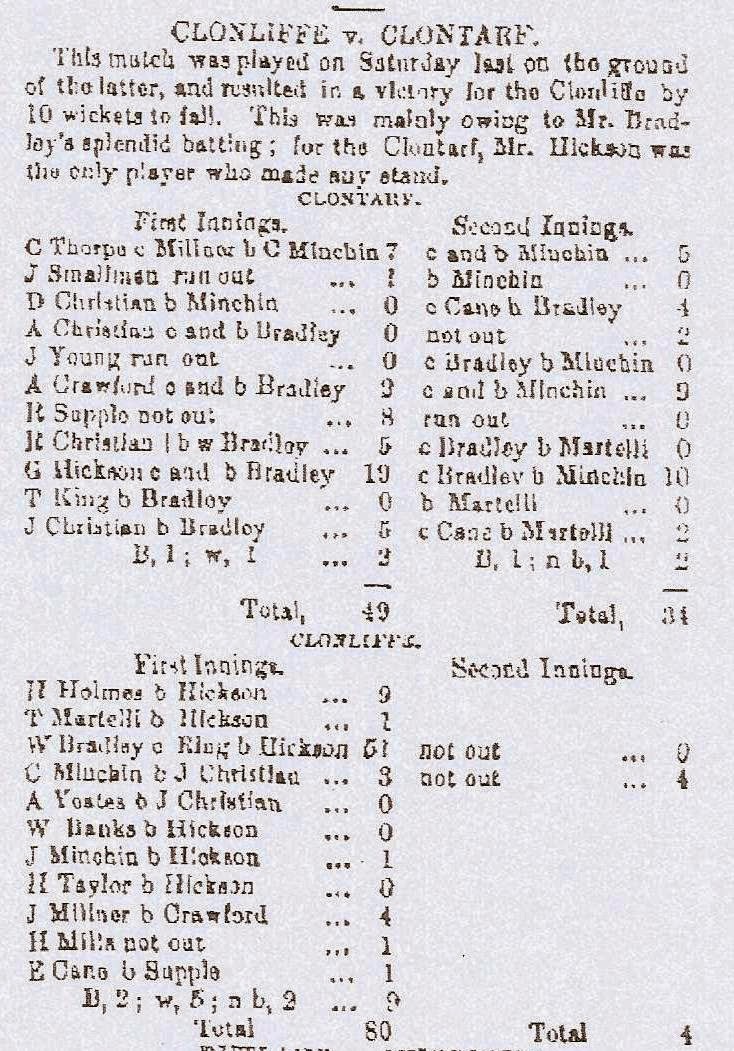
However, now that the Irish Times archive can be so easily accessed, we are able to see that cricket in Clontarf existed a long time before 1876 and indeed games involving a club going by the name of Clontarf C.C. were played early in the 1860’s.  The earliest mention found to date is from the paper printed on Wednesday 21 May 1862 involving a game against Clonliffe.  Clonliffe were comfortable winners as can be seen from the scorecard below, beating Clontarf by 10 wickets in a 2 innings game.   To put this date in some cricketing context, 1862 was the year of the first tour by an English side to Australia but it was 2 years before “over the shoulder” bowling was permitted by the rules.


The game was played at the Clontarf ground but it fails to state the location of that ground.  However another record found in the archive from 16 June 1865 reports on a local derby between Clontarf and Killester played at “the ground of the former club, North Bull”.  There would not have been any conflict with Royal Dublin Golf Club however as they only moved to Bull Island in 1889 having moved to that location from their original home at Phoenix Park. 

Once again the Clontarf XI were well beaten. The star of the Killester team was T. King who followed his 6 wickets in the first innings by taking a further 4 in the second. He also top scored in the Killester innings, scoring 27.  Interestingly, a T. King also played in the Clonliffe game for Clontarf but he was less successful in the earlier game with a pair of ducks and no wickets.


It should be no surprise that we can find cricket in the area before our “official” founding date, Ger Siggins, the well-known cricket journalist and author has traced cricket in the names of both YMCA C.C. and Strabane C.C well before their supposed beginnings.  It will be interesting to find if cricket in Clontarf (or indeed our near neighbour Killester) can be traced to before 1862 as more and more newspaper archives become easily available.

Saturday, 18 October 2014

Clontarf from the air, 1952

What was Clontarf like in the 1950's?  Well thanks to a website www.britainfromabove.org.uk we can see how it looked from the air in 1952.  There are a number of aerial shots of Clontarf and a couple include the cricket club.  The best shot is copied below and the club is in the top right of the picture.  The cricket club was on what is now the rugby pitch and the square is clearly shown.
Note you can find more photos at the website but use the search of Clow Tarf (7 photos) abd Clontarf (1 photo)


Tuesday, 5 August 2014

1984 Marigold Ladies Senior Cup Win

Clontarf once again showed their strength in depth when they defeated Claremont in this year's Marigold Cup Final at a sun drenched College Park. Claremont opened the batting, but had no answer for the Clontarf bowling attack, with the Owens sisters Stella (5 for 18 in 13 overs) and Elizabeth (4 or 28 in 12) in superb form.

The only Claremont player to show any resistance was Caroline Watson who put on a brave 16 before being given out l.b.w. off Stella Owens. The Claremont total of 55 for 9 off 25 overs was never going to be enough against the powerful Clontarf attack and some fine stroke playing by Anne Murray who made 34 not out, laid the foundation for Clontarf's emphatic nine wicket victory.

On receiving the cup, Clontarf captain Elizabeth Owens paid tribute to Claremont's brave display in their first season in Senior cricket and the Claremont Road side got some consolation when Caroline Watson received the Woman of the Matach award

This report by Colin Kerr appeared in the Irish Cricket Magazine

Note 1. Tom Prior remembers that the Woman of the Match award was given to Caroline Watson by Clarissa Pilkington for "winning the toss"!

Note 2. The Clontarf side contained 5 cricket internationals, Elizabeth (Lily) Owens, Stella Owens, Anne Murray, Susan Bray and Tracey Skoyles.  It also contained 3 hockey internationals, Jacqui Potter, Deirdre Courtney and Fiona Manning.

Back L-R L Glen, F Manning, L Spence, M Murray, T Skoyles, A Murray, J Burgess
Front L-R J Potter, S Bray, S Owens, E Owens, D Courtney, J Cassidy.

Friday, 7 February 2014

Tuesday, 17 December 2013

Earliest printed history of Clontarf Cricket Club


David Evans from the Clontarf Historical Society recently contacted us and offered to us copies of some scanned documents that had been given to him by a contact in Kilmacanogue.  Most of these documents were programmes from the fundraising concerts which the Club ran at the turn of the 1900s (more of this in a later post).  However, also included was a booklet from a fundraiser held in 1911 in the grounds of Mount Temple (now Mount Temple Comprehensive School).  The extensive booklet included all the events of the fete, a huge number of advertisements and a short history of the club to that date.  It is the earliest written history that we have found and includes some interesting details of which we were previously unaware:


Monday, 18 November 2013

Marc Jones - Candid Camaraderie


Candid Camaraderie

As I unlocked the front door of 27 Blackheath Gardens, he whom they call Beefy was coming out of his house.  Tailing him was one whom I had not identified before they disappeared behind a tree.  After greeting Beefy, the unidentified re-emerged as Paul Ryan.   They asked what I had done the night before and I answered that I had been writing a story.  Then after bidding them good day, I added to Paul “see you on Saturday”.   He screwed his face up in miscomprehension, his right eye moving down to meet his rising right nostril, replying “what?”  Only on Saturday did I realise that both Beefy and Paul were on their way to Twickenham to see Munster play.

So Paul Ryan did not play that weekend. ‘Twas not until the following Tuesday night at Phoenix Park that I saw Paul Ryan.  Before our twenty overs match when Paul and I, amongst others , were in the dressing room, a lull in the conversation was broken as Paul swiftly lifted his head looked straight at me and said “you’ve gotta write a story about me”.

“I don’t know what kind of story it would be, I don’t know you” I answered.

“Oh!” exhaled Paul Ryan “you’ll think if something”

Perhaps not at this moment though definitely some time soon after, young Paul Ryan not only said “I’m a character” but also “I’m special, I’m very special”

During the match my first ball was so far down leg side that it went for four.  The hero of our story was fielding at mid-wicket. I heard a grunt of disgust after I bowled the ball.  I walked back to my bowling mark, waiting to get the ball back from Paul.  He stared at me long enough for me to know he disapproved of it and in case I had not understood, he must have thought I would understand when he rolled the ball back to me.

For the first round of the Conqueror Cup the Clontarf side travelled to Malahide vainly waiting for the rain to stop yet stuck waiting in the dressing room until two o’clock for the match to be called off.

Captain, Ronan O’Reilly, during the team’s dressing room vigil, asked who would be available for the double header next weekend.  When Ronan asked Andrew Cullen, the latter’s face grew solemn with disappointment before, with bowed head, saying “oh!, I’ve got to go away that weekend”

“Bah” exclaimed Paul, pointing at Andrew “don’t try and keep a straight face” He turned to Ronan and said “ah! Look at him”

By this time Andrew had stopped looking disappointed about being in Greece the following weekend, and had begun to laugh in fact and also to have his hands out and body crouched in readiness for the arrival of Paul Ryan, charging across the dressing room straight for him. Paul forced Andrew into the corner of the dressing room, larks for all to see, rumbling about Ronan’s kit.  “get off my gear! C’mon Paul” said Ronan. Paul looked surprised at Ronan, saying with incredulity “ id you hear what he said. Oh I’ve got to go away that weekend – ha ha ha.  Look at him! I’ve got to go away that weekend – he looks really disappointed”.

A week or two later as I was leaving The Yacht, I came across Paul Ryan.  He urged me to stay for one more drink and kindly bought me a Vodka. We clinked glasses I took a sip while Paul finished off his (at least) two thirds full pint.  He confessed to me that he was a fitness fanatic.

“You’ve got to write that article remember”

“I’ve not forgotten”

“And you can’t make things up, it’s gotta be real”    

“I’ll write candidly”

“Oh! Good, good, good, good”

After our victory against CYM I met up with a friend who was in Dublin for a few days.  Someone in the pub heard my (Australian) accent, asked what I was doing here and, on finding out I was a Clontarf cricketer, pointed to his friend Darragh, a member of Clontarf Rugby Club. “aha, so you know Paul Ryan then”

“Oh, Paul Ryan! Manic bastard.  He knows all the words to heaps of songs and he sing ‘em all.  You know that song Maniac?”

“Yes”

“ And you know the film clip was done at the Club”

“Yes”

“Well Ryner knows all the words to that one, too, and he sings the whole thing in the shower when we win”.

 
Paul Ryan in "playfully" mood at the 2000 team photo shoot, Marc Jones is second from left in back row

Back at Malahide for the rescheduled date of our first Cup match.  Start delayed by rain.  Many of the lads in the team ate breakfast rolls wrapped in foil upon arrival in the dressing room.  Mr. Desmond McCann also brought a bag of grapes with his breakfast roll.  As the rolls were finished and foil scrunched up, grapes were thrown from one end of the dressing room to mouths open at the other end.  Here, one Paul Ryan smelt opportunity and urged Thinnus to watch slowly the oncoming grape, smiling, winking and nodding his head afterwards.  Mr. McCann said “Thinnus, watch the grape and Ryner as well.”  Even the warning did not stop Paul from throwing the foil at Thinnus’ mouth.

And this, ladies and gentlemen, is all I can say for now regarding he who goes by the name of “The General” Why?

General Mayhem I was told

Marc Jones, June 2000

(This article first appeared in the Club Brochure 2000)

Wednesday, 30 October 2013

Women's cricket in the 1970s


While women’s cricket flourished during the 1940s and 50s, it had died a slow death and was virtually extinct by the mid-1970s. In 1975 Jenny Halliday and Barbara Schmidt organised a  game during Trinity Week.  This was the spark that reignited the game and the women of Clontarf were so inspired that they took to the game to such an extent that they dominated the early years of Leinster Women’s Cricket. 

The summer of 1975 was spent organising and practising. Games against Leinster and Phoenix were arranged and a mixed friendly with the men’s team was organised in September 1975.  Over the winter, Isolde Howard, a member of Leinster CC and a woman who had been at the forefront of women’s cricket in its first incarnation in Leinster, contacted clubs to attend a meeting with a view to organising a league for the following summer.  Five clubs attended the meeting, Railway Union, Leinster, Phoenix, Merrion and Clontarf and arrangements made.  In April 1976, 30 attended the Inaugural Annual General Meeting of Clontarf Cricket Club, Ladies Section and Phyllis Spence was voted in as Captain.

The 1976 season was a resounding success, with the First XI playing 8 league games and winning seven.  The team was coached by Bill Dalton-Brown, Kevin Harding and Brian Bunworth and the outstanding batswoman was Susan Cassidy who scored 186 runs at 46.5. The top bowler was Marie Coffey who took 31 wickets at a remarkable 3.6.  While Marie had played for Clontarf in the 1950s, in contrast her bowling partner was the 11 year old Stella Owens whose 26 wickets only cost 4.38 runs each including a hat trick against Phoenix.   The Irish Times reported 3 games in one edition, in all cases Clontarf bowled first and dismissed Railway Union for 22, Merrion for 45 and Leinster for 37. Clontarf were not just fielding one team however and others teams played numerous friendly games including one in Mullingar. The numbers playing were incredibly strong and evidence of this was the six a side tournament run on 10 July 1976.  Clontarf fielded 6 teams in the competition, however other Leinster clubs also participated bring the total playing to 72 and the seed of an idea for an annual Leinster-wide 6 a side competition was sown.  This would become the famous, or indeed infamous, Pernod competition, famed for the après match activity.

The off season between the 76 and 77 seasons saw the new committee hard at work and in April 1977 a press conference was held to announce the inaugural Tyler Cup, a 25 over cup competition. 
Marie Coffey, Phyllis Spence, Isolda Howard and Clarrissa Crawford
 
The work of the committee lead to an incredible amount of press coverage for the new competition and Clontarf featured heavily in this press interest. The Irish, Sunday and Evening Press newspapers carried articles and photos on Marie Coffey, Stella Owens as well as members of Leinster and Phoenix. 
Press coverage at Clontarf
Press coverage is of course a double edged sword and following a photograph of Clontarf’s Mary Taaffe in The Irish Times of 1 July, the letter writers made their views known to the Editor.  
Unwanted Press coverage!
 
The first running of the “Pernod” took place on 1 June 1977, an entrance fee of £3 entitled entry to the cricket competition, tea and disco afterwards and of course a sample of the sponsor’s wares.  Back in the regular competitions, Clontarf won the Tyler Cup, beating Phoenix. Susan Cassidy top scored with 47 not out as Clontarf made 116 for 3, however Phoenix could only manage 51 in reply as Coffey and Owens ripped through the home team batting.  In September, Clontarf had a date with Leinster in the League Final and it looked as through a straightforward double was on the cards as Clontarf reached 50 for 3 with 2 overs remaining chasing Leinster’s 52 for 6.  However a Colette Brannagan hat trick caused some panic before Mary Hackett hit a boundary in the final over. Mary finished the season with 522 runs and an extraordinary average of 174 to win the Crawford Trophy and Marie Coffey won the Harrison Trophy in taking 39 wickets at 3.7 runs each.  It was Marie’s third time to win the bowling award, having won it the previous year and in 1955.
The Clontarf Double winning team of 1977 with individual award winners
 
In an incredibly short time Women’s cricket had re-established itself (thanks mainly to a small and very dedicated band of organisers) and Clontarf was the club that took the lead on the field.  Others such as Leinster, Merrion and Phoenix would step up to the plate in the coming years before a new band of Clontarf women  would once again dominate the sport in the 1980’s – but more of that later.

(Many thanks to Phyllis Spence for the loan of her archive which records the early days of Clontarf Ladies)

Tuesday, 10 September 2013

Schweppes Cup Final 1990


The wonderful Irish Senior Cup win of 2013 has raised many questions from our younger members about our only other Final appearance (it was called the Schweppes Cup in those days).  While the Final result was a disappointing one, it was a terrific cup run with great games all the way through.  This is the story of our 1990 Schweppes Cup journey.

We began the competition in the second round, there was only one game in Round 1, at home to Brigade from the North West.  Batting first we set a target of 239 for 8, with Deryck Vincent and Pete Scolari hitting 50s.  In reply, Brigade could only manage 137 with our two left armers, Gerry Kirwan and Feargal O’Mahony picking up three wickets each.  Round 2 paired us against Phoenix who batted first and were looking good at 100 for 1, however a fine spell of bowling from Brian MacNeice (4 for 25) restricted Phoenix to 162.  A comfortable 4 wicket victory ensued with Vincent again in the runs making 88.

The draw for the fourth round was not kind, as we drew the mighty Warringstown, though at least it was in Castle Avenue.  Warringstown were one of the strongest teams in the country littered with famous names, Harrisons and Nelsons amongst the international stars.  But what a day.  Restricting them to 174 was a fantastic effort in the field, on a hot day with a great wicket.  Then to chase without losing a wicket was the icing on the cake.  Vincent (101 not out) and Michael Rea (74 not out) ensured a famous win.

And so to the semi-final and a bus journey to Woodvale in Belfast.  Woodvale batted first and lead by the Irish captain Stephen Warke set a challenging total of 209 for 3.  That was not quite the full story however as Feargal O’Mahony had dislocated his shoulder and Clontarf captain Brendan Bergin pulled a hamstring when in the field.  However most crippling was the nerves which threatened to overcome the team as they battled to reach the score.  Fortunately the Woodvale keeper also had the jitters and he missed Vincent on three occasions as he scrapped his way to 78. Enda McDermott took over when he was out and when he departed in the 47th over there was still 21 to win.  Enter the injured Captain, who, literally on one leg, smacked the winning runs for a famous win.  The bus journey home was epic too, so good that the bus driver missed the turn and we ended up taking a detour through Armagh somehow.

We will leave it to Sean Pender of The Irish Times to report on the Final which was against Lurgan.

McCollum swings final in Lurgan’s favour


Ross McCollum, whose three Ireland appearances two years ago were against county opposition but who has yet to be given a chance against weaker international teams, showed at Rathmines on Saturday that if the bowling is not of high quality he will literally make mincemeat of it.

In making a scorching 89 ball 91 that irreversibly turned the Schweppes Cup final in Lurgan’s favour, the 26 year old clubbed eight fours and five sixes off a Clontarf attach that could find no way of containing him.

Only Feargal O’Mahony, bowling as well as he ever has, managed to keep him in any kind of check. Before being forced to retire with an injured finger, the Clontarf left arm spinner send down 9.2 overs for a mere 12 runs – and half of that total came in a single blow from McCollum.

Clontarf could not be faulted or lack of effort in the field, but three possible run outs in addition to the two achieved, were muffed through ill directed returns to the stumps.  Two fine catches were taken by Michael Rea, the first on the long on boundary accounting for McCollum, and two also by John Daly, the first a diving leg-side effort to dismiss his fellow wicket-keeper Tom Guy.

A run out in the very first over had started the day off on an ecstatic note for Clontarf. A brilliant stooping stop on the run by Alan McClean led to both Guy and Subash Kshirasgar being caught out of their ground and after Guy had initially started back towards the pavilion the umpires ruled that Lurgan’s Indian professional was, in fact, the man dismissed.

Guy fell in the second over with only two runs on the board, but then came a magnificent 148 run stand between McCollum and Dessie Neill, the latter hitting seven fours in his 52 and follow up contributions from the Hunter brothers that enabled Lurgan to reach 251 fir 9 off their 50 overs and have 73 runs to spare at the end.

A long struggle now faced Clontarf if the match was to be won and the first over dismissal of Deryck Vincent did not augur well for its successful completion.  The left handed opener got a touch outside the off stump to a fine delivery from Alan Johnston and Guy jubilantly took the first of three catches.

Though Rea, McClean, Enda McDermott, Brendan Bergin and particularly Peter Scolari subsequently all played double figure cameo innings, Clontarf’s real hope of victory disappeared with the departure of Vincent, century maker against YMCA in his previous appearance in a final at Rathmines.

Johnston, remorseless in accuracy and length, also claimed he wickets of McDermott and John Barry, brought off a close to the wickets diving catch to get rid of Rea.  Kshirasgar, Neill shinning in a dual role and Alan Donnelly, a superb fielder, each chipped in with 2 wickets at economical cost, there was no doubting Lurgan’s real hero. With ferocious hitting Ross McCollum had dug the Northerners out of a hole from which there did not appear to be any possible escape.


Lurgan

S Kshirasgar run out                                        0

T Guy c Daly b Barry                                        0

D Neill run out                                                   52

R McCollum c Rea b Kirwan                          91

G Hunter lbw MacNeice                                                47

A Hunter c McClean b Scolari                      24

A Donnelly c Rea b MacNeice                     3

R Burton b Vincent                                          4

A Johnston not out                                         11

A Woods c Daly b MacNeice                        5

P Lyness not out                                               0

Extras                                                                    14

Total for 9 wickets                                           251

Bowling

MacNeice 10-1-56-3, Barry 5-0-40-1, Vincent 6-1-26-1, Kirwan 9.4-0-65-1, O’Mahony 9.2-4-12-0, Scolari 10-1-43-1

Clontarf

D Vincent c Guy b Johnston                         1

M Rea c Johnston b Kshirasgar                   19

A McClean c A Hunter b Kshirasgar           34

P Scolari lbw Neill                                             30

J Daly b Donnelly                                              7

E McDermott b Johnston                              28

B Bergin c Guy b Neill                                     20

F O’Mahony run out                                       5

B MacNeice not out                                        5

J Barry c Guy b Johnston                               3

G Kirwan b Donnelly                                       6

Extras                                                                    20

Total                                                                      178

Bowling

Johnston 9-2-23-3, Woods 4-1-15-0, Kshirasgar 10-1-27-2, Lyness 6-0-22-0, Neill 9-0-40-2, Donnelly 9.1-0-33-2


Thursday, 8 August 2013

Cup Final win in 1977 for the Ladies


Clontarf women best in one-sided decider by Sean Pender


The idea that women’s cricket has a long way to go to establish itself on a sound footing in Leinster was shown to be a complete myth when at the Phoenix Park yesterday in a splendid if somewhat one sided provincial final Clontarf defeated Phoenix by 65 runs.

As Clontarf, after winning the toss, cruised comfortably towards their expected victory Stella Owens, 11 year old bundle of energy who captured five wickets for 24 runs, proved herself indisputably the player of the match.

A lovely action at the end of a smooth if rather long run enabled her to maintain remarkable accuracy and control of length in an uninterrupted 95 minute spell of 14 overs.  At one stage she was on a hat trick and if she did not herself account for the final wicket had the last say when taking a brilliant catch of the bowling of Marie Coffey to dismiss Wendy Blennerhassett and finish the match.

Phoenix had suffered a double blow when with the total at nine runs for two wickets their top bat, Blennerhassett mistimed a stroke onto her face and Gillian Mellon, who had set out on what would have been a comfortable single, hesitated on seeing the plight of her partner and was run out on a superb throw from square leg by Mary Hackett which struck the stumps on full pitch.

Blennerhassett after medical attention, bravely came back on the fall of the seventh wicket, but by then the damage was irreparable. Though there was some gritty batting in the crisis from Iowa born, Barbara Schmidt, the Phoenix captain and Sue Cornish.

Despite some fine bowling by Gwen Jeffares, Mary Hackett and Mary Taafe had sent Clontarf on a match winning start with a stand of 38 for the first wicket. When Hackett was caught by Marita Shaw off the bowling of Gwen Jeffares for 18, it was only the third time this season she had been dismissed and she still incredibly has an average of over 200.

Sue Cassidy, top batsman in the province last season but certain now to be dethroned by Hackett, was unfortunate not to get a half century, finishing with 47 not out, which included 4 fours. In all she batted 71 minutes but was pipped for her side’s batting award by Taafe, the mainstay of the Clontarf innings who was at the wicket 90 minutes for her 374.  All three of Clontarf’s scorers have easy attractive styles and were always entertaining to watch.

The fielding of both sides looked good without being exceptional. Schmidt, Frances Douglas, Jenny Halliday, Vivienne MacMahon and Cornish of Phoenix and Owens, Fiona Smyth, Taafe and wicketkeeper Kay Lambert stood out in good company.  Clontarf in particular, were quick in anticipation and on the move and with the bowling so accurate and tidy and Phyllis Spence setting an intelligent field – so hard, in fact that of their total of 51 all but two twos came in singles.

How big a success after a long gap was this revival of the women’s cup final? An international player marvelling at the size of the attendance inquired, with no small degree of seriousness: “ is this the end of the men’s game in Dublin?”


Clontarf


Mary Hackett c Shaw by Jeffares                              18

Mary Taafe c and b Jeffares                                        37

Sue Cassidy not out                                                        47

Kay Lambert c Cornish b Jeffares                              3

Shauna Murphy not out                                                2

Extras                                                                                    9

Total                                                                                      116

Did not bat Phyllis Spence, Marie Coffey, Sharon Dixon, Fiona Smyth, Mary Bray, Stella Owens.

Bowling: Blennerhassett 16-3-47-0, Jeffares 17-2-48-3, Freer 2-0-10-0

Phoenix


G Mellon run out                                                             4

F Douglas b Coffey                                                          0

A Waldron c Lambert b Owens                                   0

W Blennerhassett c Owens b Coffey                       19

M Shaw b Owens                                                             0

J Halliday b Coffey                                                           1

G Jeffares b Owens                                                        0

V MacMahon lbw Owens                                             3

B Schmidt b Owens                                                         8

S Cornish c Hackett b Coffey                                       8

P Freer not out                                                                                 2

Extras                                                                                    6

Total                                                                                      51

Bowling:  Marie Coffey  4-21, Stella Owens 5-24