Monday, 30 March 2015

1876 – the year we were founded?

1876 – the year we were founded?

It is generally assumed that Clontarf Cricket Club was founded in 1876.  Without documentary proof however, it is hard to verify the actual date.  The earliest written history was included in a brochure for a Fund Raising Fete in 1911 and it admitted that it was “hard to assign a date to its formation” merely confirming  that a healthy organisation existed in the middle 1880's. This is indisputable, we have a notebook from 1886 confirming a membership of over 50 and photographs exist from as early as 1883. What we do not have however is minute books or similar dating back into the 1870's.  So from where did the date of 1876 appear?  It is first mentioned in the Club’s annual fixture book in the 1950’s and appears in the history written for the opening of the new ground in May 1958 as a definitive date.  This history quotes from the Irish Sportsman from 27 July 1878 who “welcome the suburban Club, Clontarf, and wish them every success in their endeavor to promote so healthy and manly a sport in their own district”.  This quotation certainly makes a reasonable case for a foundation in the mid 1870’s. 

However, now that the Irish Times archive can be so easily accessed, we are able to see that cricket in Clontarf existed a long time before 1876 and indeed games involving a club going by the name of Clontarf C.C. were played early in the 1860’s.  The earliest mention found to date is from the paper printed on Wednesday 21 May 1862 involving a game against Clonliffe.  Clonliffe were comfortable winners as can be seen from the scorecard below, beating Clontarf by 10 wickets in a 2 innings game.   To put this date in some cricketing context, 1862 was the year of the first tour by an English side to Australia but it was 2 years before “over the shoulder” bowling was permitted by the rules.
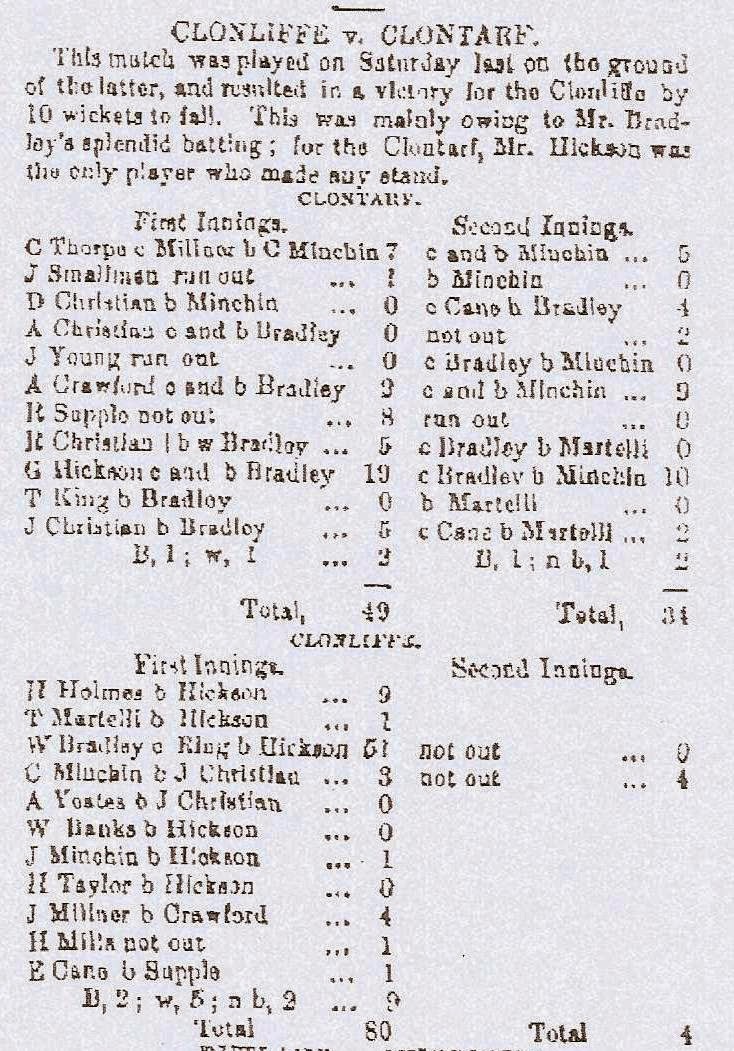


The game was played at the Clontarf ground but it fails to state the location of that ground.  However another record found in the archive from 16 June 1865 reports on a local derby between Clontarf and Killester played at “the ground of the former club, North Bull”.  There would not have been any conflict with Royal Dublin Golf Club however as they only moved to Bull Island in 1889 having moved to that location from their original home at Phoenix Park. 

Once again the Clontarf XI were well beaten. The star of the Killester team was T. King who followed his 6 wickets in the first innings by taking a further 4 in the second. He also top scored in the Killester innings, scoring 27.  Interestingly, a T. King also played in the Clonliffe game for Clontarf but he was less successful in the earlier game with a pair of ducks and no wickets.


It should be no surprise that we can find cricket in the area before our “official” founding date, Ger Siggins, the well-known cricket journalist and author has traced cricket in the names of both YMCA C.C. and Strabane C.C well before their supposed beginnings.  It will be interesting to find if cricket in Clontarf (or indeed our near neighbour Killester) can be traced to before 1862 as more and more newspaper archives become easily available.

Saturday, 18 October 2014

Clontarf from the air, 1952

What was Clontarf like in the 1950's?  Well thanks to a website www.britainfromabove.org.uk we can see how it looked from the air in 1952.  There are a number of aerial shots of Clontarf and a couple include the cricket club.  The best shot is copied below and the club is in the top right of the picture.  The cricket club was on what is now the rugby pitch and the square is clearly shown.
Note you can find more photos at the website but use the search of Clow Tarf (7 photos) abd Clontarf (1 photo)


Tuesday, 5 August 2014

1984 Marigold Ladies Senior Cup Win

Clontarf once again showed their strength in depth when they defeated Claremont in this year's Marigold Cup Final at a sun drenched College Park. Claremont opened the batting, but had no answer for the Clontarf bowling attack, with the Owens sisters Stella (5 for 18 in 13 overs) and Elizabeth (4 or 28 in 12) in superb form.

The only Claremont player to show any resistance was Caroline Watson who put on a brave 16 before being given out l.b.w. off Stella Owens. The Claremont total of 55 for 9 off 25 overs was never going to be enough against the powerful Clontarf attack and some fine stroke playing by Anne Murray who made 34 not out, laid the foundation for Clontarf's emphatic nine wicket victory.

On receiving the cup, Clontarf captain Elizabeth Owens paid tribute to Claremont's brave display in their first season in Senior cricket and the Claremont Road side got some consolation when Caroline Watson received the Woman of the Matach award

This report by Colin Kerr appeared in the Irish Cricket Magazine

Note 1. Tom Prior remembers that the Woman of the Match award was given to Caroline Watson by Clarissa Pilkington for "winning the toss"!

Note 2. The Clontarf side contained 5 cricket internationals, Elizabeth (Lily) Owens, Stella Owens, Anne Murray, Susan Bray and Tracey Skoyles.  It also contained 3 hockey internationals, Jacqui Potter, Deirdre Courtney and Fiona Manning.

Back L-R L Glen, F Manning, L Spence, M Murray, T Skoyles, A Murray, J Burgess
Front L-R J Potter, S Bray, S Owens, E Owens, D Courtney, J Cassidy.

Friday, 7 February 2014

Tuesday, 17 December 2013

Earliest printed history of Clontarf Cricket Club


David Evans from the Clontarf Historical Society recently contacted us and offered to us copies of some scanned documents that had been given to him by a contact in Kilmacanogue.  Most of these documents were programmes from the fundraising concerts which the Club ran at the turn of the 1900s (more of this in a later post).  However, also included was a booklet from a fundraiser held in 1911 in the grounds of Mount Temple (now Mount Temple Comprehensive School).  The extensive booklet included all the events of the fete, a huge number of advertisements and a short history of the club to that date.  It is the earliest written history that we have found and includes some interesting details of which we were previously unaware:


Monday, 18 November 2013

Marc Jones - Candid Camaraderie


Candid Camaraderie

As I unlocked the front door of 27 Blackheath Gardens, he whom they call Beefy was coming out of his house.  Tailing him was one whom I had not identified before they disappeared behind a tree.  After greeting Beefy, the unidentified re-emerged as Paul Ryan.   They asked what I had done the night before and I answered that I had been writing a story.  Then after bidding them good day, I added to Paul “see you on Saturday”.   He screwed his face up in miscomprehension, his right eye moving down to meet his rising right nostril, replying “what?”  Only on Saturday did I realise that both Beefy and Paul were on their way to Twickenham to see Munster play.

So Paul Ryan did not play that weekend. ‘Twas not until the following Tuesday night at Phoenix Park that I saw Paul Ryan.  Before our twenty overs match when Paul and I, amongst others , were in the dressing room, a lull in the conversation was broken as Paul swiftly lifted his head looked straight at me and said “you’ve gotta write a story about me”.

“I don’t know what kind of story it would be, I don’t know you” I answered.

“Oh!” exhaled Paul Ryan “you’ll think if something”

Perhaps not at this moment though definitely some time soon after, young Paul Ryan not only said “I’m a character” but also “I’m special, I’m very special”

During the match my first ball was so far down leg side that it went for four.  The hero of our story was fielding at mid-wicket. I heard a grunt of disgust after I bowled the ball.  I walked back to my bowling mark, waiting to get the ball back from Paul.  He stared at me long enough for me to know he disapproved of it and in case I had not understood, he must have thought I would understand when he rolled the ball back to me.

For the first round of the Conqueror Cup the Clontarf side travelled to Malahide vainly waiting for the rain to stop yet stuck waiting in the dressing room until two o’clock for the match to be called off.

Captain, Ronan O’Reilly, during the team’s dressing room vigil, asked who would be available for the double header next weekend.  When Ronan asked Andrew Cullen, the latter’s face grew solemn with disappointment before, with bowed head, saying “oh!, I’ve got to go away that weekend”

“Bah” exclaimed Paul, pointing at Andrew “don’t try and keep a straight face” He turned to Ronan and said “ah! Look at him”

By this time Andrew had stopped looking disappointed about being in Greece the following weekend, and had begun to laugh in fact and also to have his hands out and body crouched in readiness for the arrival of Paul Ryan, charging across the dressing room straight for him. Paul forced Andrew into the corner of the dressing room, larks for all to see, rumbling about Ronan’s kit.  “get off my gear! C’mon Paul” said Ronan. Paul looked surprised at Ronan, saying with incredulity “ id you hear what he said. Oh I’ve got to go away that weekend – ha ha ha.  Look at him! I’ve got to go away that weekend – he looks really disappointed”.

A week or two later as I was leaving The Yacht, I came across Paul Ryan.  He urged me to stay for one more drink and kindly bought me a Vodka. We clinked glasses I took a sip while Paul finished off his (at least) two thirds full pint.  He confessed to me that he was a fitness fanatic.

“You’ve got to write that article remember”

“I’ve not forgotten”

“And you can’t make things up, it’s gotta be real”    

“I’ll write candidly”

“Oh! Good, good, good, good”

After our victory against CYM I met up with a friend who was in Dublin for a few days.  Someone in the pub heard my (Australian) accent, asked what I was doing here and, on finding out I was a Clontarf cricketer, pointed to his friend Darragh, a member of Clontarf Rugby Club. “aha, so you know Paul Ryan then”

“Oh, Paul Ryan! Manic bastard.  He knows all the words to heaps of songs and he sing ‘em all.  You know that song Maniac?”

“Yes”

“ And you know the film clip was done at the Club”

“Yes”

“Well Ryner knows all the words to that one, too, and he sings the whole thing in the shower when we win”.

 
Paul Ryan in "playfully" mood at the 2000 team photo shoot, Marc Jones is second from left in back row

Back at Malahide for the rescheduled date of our first Cup match.  Start delayed by rain.  Many of the lads in the team ate breakfast rolls wrapped in foil upon arrival in the dressing room.  Mr. Desmond McCann also brought a bag of grapes with his breakfast roll.  As the rolls were finished and foil scrunched up, grapes were thrown from one end of the dressing room to mouths open at the other end.  Here, one Paul Ryan smelt opportunity and urged Thinnus to watch slowly the oncoming grape, smiling, winking and nodding his head afterwards.  Mr. McCann said “Thinnus, watch the grape and Ryner as well.”  Even the warning did not stop Paul from throwing the foil at Thinnus’ mouth.

And this, ladies and gentlemen, is all I can say for now regarding he who goes by the name of “The General” Why?

General Mayhem I was told

Marc Jones, June 2000

(This article first appeared in the Club Brochure 2000)

Wednesday, 30 October 2013

Women's cricket in the 1970s


While women’s cricket flourished during the 1940s and 50s, it had died a slow death and was virtually extinct by the mid-1970s. In 1975 Jenny Halliday and Barbara Schmidt organised a  game during Trinity Week.  This was the spark that reignited the game and the women of Clontarf were so inspired that they took to the game to such an extent that they dominated the early years of Leinster Women’s Cricket. 

The summer of 1975 was spent organising and practising. Games against Leinster and Phoenix were arranged and a mixed friendly with the men’s team was organised in September 1975.  Over the winter, Isolde Howard, a member of Leinster CC and a woman who had been at the forefront of women’s cricket in its first incarnation in Leinster, contacted clubs to attend a meeting with a view to organising a league for the following summer.  Five clubs attended the meeting, Railway Union, Leinster, Phoenix, Merrion and Clontarf and arrangements made.  In April 1976, 30 attended the Inaugural Annual General Meeting of Clontarf Cricket Club, Ladies Section and Phyllis Spence was voted in as Captain.

The 1976 season was a resounding success, with the First XI playing 8 league games and winning seven.  The team was coached by Bill Dalton-Brown, Kevin Harding and Brian Bunworth and the outstanding batswoman was Susan Cassidy who scored 186 runs at 46.5. The top bowler was Marie Coffey who took 31 wickets at a remarkable 3.6.  While Marie had played for Clontarf in the 1950s, in contrast her bowling partner was the 11 year old Stella Owens whose 26 wickets only cost 4.38 runs each including a hat trick against Phoenix.   The Irish Times reported 3 games in one edition, in all cases Clontarf bowled first and dismissed Railway Union for 22, Merrion for 45 and Leinster for 37. Clontarf were not just fielding one team however and others teams played numerous friendly games including one in Mullingar. The numbers playing were incredibly strong and evidence of this was the six a side tournament run on 10 July 1976.  Clontarf fielded 6 teams in the competition, however other Leinster clubs also participated bring the total playing to 72 and the seed of an idea for an annual Leinster-wide 6 a side competition was sown.  This would become the famous, or indeed infamous, Pernod competition, famed for the après match activity.

The off season between the 76 and 77 seasons saw the new committee hard at work and in April 1977 a press conference was held to announce the inaugural Tyler Cup, a 25 over cup competition. 
Marie Coffey, Phyllis Spence, Isolda Howard and Clarrissa Crawford
 
The work of the committee lead to an incredible amount of press coverage for the new competition and Clontarf featured heavily in this press interest. The Irish, Sunday and Evening Press newspapers carried articles and photos on Marie Coffey, Stella Owens as well as members of Leinster and Phoenix. 
Press coverage at Clontarf
Press coverage is of course a double edged sword and following a photograph of Clontarf’s Mary Taaffe in The Irish Times of 1 July, the letter writers made their views known to the Editor.  
Unwanted Press coverage!
 
The first running of the “Pernod” took place on 1 June 1977, an entrance fee of £3 entitled entry to the cricket competition, tea and disco afterwards and of course a sample of the sponsor’s wares.  Back in the regular competitions, Clontarf won the Tyler Cup, beating Phoenix. Susan Cassidy top scored with 47 not out as Clontarf made 116 for 3, however Phoenix could only manage 51 in reply as Coffey and Owens ripped through the home team batting.  In September, Clontarf had a date with Leinster in the League Final and it looked as through a straightforward double was on the cards as Clontarf reached 50 for 3 with 2 overs remaining chasing Leinster’s 52 for 6.  However a Colette Brannagan hat trick caused some panic before Mary Hackett hit a boundary in the final over. Mary finished the season with 522 runs and an extraordinary average of 174 to win the Crawford Trophy and Marie Coffey won the Harrison Trophy in taking 39 wickets at 3.7 runs each.  It was Marie’s third time to win the bowling award, having won it the previous year and in 1955.
The Clontarf Double winning team of 1977 with individual award winners
 
In an incredibly short time Women’s cricket had re-established itself (thanks mainly to a small and very dedicated band of organisers) and Clontarf was the club that took the lead on the field.  Others such as Leinster, Merrion and Phoenix would step up to the plate in the coming years before a new band of Clontarf women  would once again dominate the sport in the 1980’s – but more of that later.

(Many thanks to Phyllis Spence for the loan of her archive which records the early days of Clontarf Ladies)